
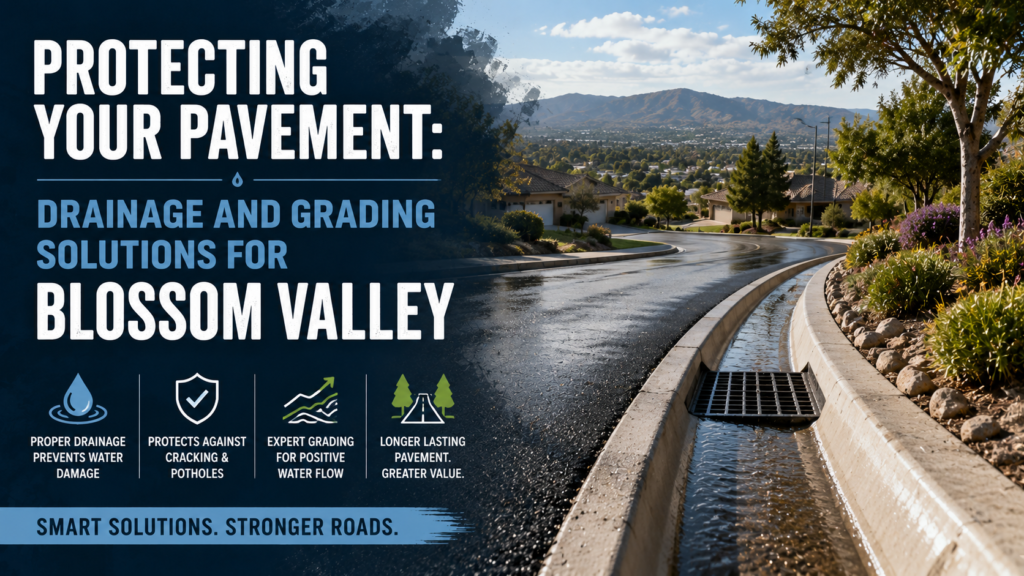
Blossom Valley is one of San Diego’s hidden gems, characterized by its scenic beauty and rolling terrain. However, for property owners, this beautiful landscape often translates into one significant challenge: water management. When it rains in Blossom Valley, water flows downhill, and your driveway or parking lot sits directly in its path. That is why selecting an Asphalt Contractor Blossom Valley recommends is not just about laying asphalt it is about controlling where the water goes.
Understanding Surface Water Hydrology
Before any asphalt is placed, a contractor must study the property’s drainage patterns. Where does water come from during a 10-year storm event? Where does it want to go? Asphalt is impermeable, meaning it sheds 100% of the rain that falls on it. If the driveway is at the bottom of a slope, it becomes a dam, forcing water to pool or flow across the surface.
The solution is grading: reshaping the land to create a path for water that avoids the paved surface. In Blossom Valley, this often means creating diversion berms (small earthen ridges) uphill of the driveway to channel water around it rather than across it.
The Crown: A Simple but Critical Feature
A flat driveway might seem logical, but it is a recipe for ponding water. Standing water on asphalt is destructive for several reasons. First, it accelerates oxidation in the submerged area. Second, freeze-thaw cycles (rare but possible in Blossom Valley) cause water to expand and crack the pavement. Third, standing water softens the asphalt binder, leading to raveling.
Professional asphalt installation includes a “crown”a gentle ridge running down the centerline of the driveway. The driveway slopes away from the crown at a rate of 1-2% (approximately ¼ inch per foot). A 12-foot wide driveway with a proper crown will have 1.5 inches of drop from the center to each edge, ensuring that water runs off within minutes of a storm ending.
French Drains and Interceptor Drains
Sometimes, grading alone cannot solve the water problem. If the driveway crosses a natural drainage swale or if the surrounding land is higher than the proposed pavement, interceptor drains are necessary.
A French drain is a trench filled with gravel containing a perforated pipe at the bottom. Water enters the trench, flows into the pipe, and is discharged downhill of the driveway. For Blossom Valley properties, French drains are often installed along the uphill edge of the driveway to intercept sheet flow before it reaches the asphalt. The drain discharges into a dry well or a vegetated swale.
Curb and Gutter Alternatives
In urban areas, concrete curbs and gutters collect and channel water. In rural Blossom Valley, concrete curbs are rare because they are expensive and can look out of place. Alternatives include asphalt curbing (a small ridge extruded from the paver) or simply a compacted gravel shoulder.
Asphalt curbing is effective for directing water toward a specific discharge point. It can be installed as a “speed bump” style curb or a vertical curb. However, for most rural driveways, a well-compacted gravel shoulder with a gradual slope serves the same purpose at a lower cost.
The Dangers of Hydrostatic Pressure
One of the most misunderstood pavement failures is caused by hydrostatic pressure. When soil beneath the asphalt becomes saturated with water, the water pressure increases. If the asphalt is sealed perfectly (no cracks), water pressure can build up to the point where it lifts the pavement from below, creating a bulge or a blowout.
This is why crack sealing is not just about keeping water out of the base it is about allowing water vapor to escape. Some modern pavements include small “weep holes” or are intentionally left unsealed in specific areas to relieve hydrostatic pressure. The alternative is catastrophic failure during the first wet season.
Permeable Asphalt: A Green Solution
Many Blossom Valley property owners are environmentally conscious and ask about permeable (porous) asphalt. Permeable asphalt looks like standard asphalt but has larger air voids (15-20% instead of 5-7%). Water flows through the pavement into a stone reservoir below, where it slowly infiltrates into the native soil.
Permeable asphalt is excellent for reducing runoff and recharging groundwater. However, it is not suitable for all Blossom Valley locations. It requires well-draining native soils (sandy or gravelly) and cannot be used on slopes greater than 5% or in areas with heavy clay soils. It also requires annual vacuuming to prevent the pores from clogging with dust and leaves.
Drainage Swales: Working with Nature
Instead of fighting water, smart contractors work with it. A drainage swale is a shallow, vegetated channel that carries water safely across a property. Swales are preferable to pipes because they are self-cleaning, provide habitat, and filter pollutants.
If a driveway must cross a swale, a “dip” or “low water crossing” can be constructed. The driveway dips down to meet the bottom of the swale, allowing water to flow over the pavement during heavy rains. The asphalt in a low water crossing must be extra thick (6-8 inches) and reinforced with geogrid to resist washing out. Warning signs and depth markers are recommended for driver safety.
Preventing Erosion Around Pavement Edges
The edge of any asphalt pavement is vulnerable to erosion. In Blossom Valley, with its hillsides and loose soils, edge erosion is a primary cause of pavement failure. When water runs along the edge of the driveway, it undercuts the base, causing the asphalt to crack and fall away.
Vegetation is the best erosion control. Planting deep-rooted grasses or shrubs along the pavement edge stabilizes the soil. However, roots should not be allowed to grow under the pavement. A buffer strip of compacted gravel (12-18 inches wide) along the edge creates a transition zone that dissipates the energy of flowing water before it reaches the soil.
Seasonal Considerations for Installation
Blossom Valley experiences distinct wet and dry seasons. The best time for asphalt installation is late spring through early fall when the ground is dry and temperatures are warm. Winter installation is possible but risky rain can wash out an unprepared base, and cold temperatures prevent proper compaction.
If installation must occur in winter, contractors use “dry weather windows” (72+ hours of forecasted dry weather) and may add anti-stripping agents to the asphalt mix to improve adhesion between the binder and the aggregate in damp conditions.
Long-Term Drainage Maintenance
Even the best drainage system requires maintenance. Property owners should inspect their driveway during and after the first heavy rain of the season. Look for:
- Ponding water (indicates a low spot or clogged drain)
- Soil washout at the edges
- Vegetative debris blocking swales or drain inlets
- Sediment accumulation in French drains
Cleaning drains and swales annually, along with sealing cracks, will ensure that the asphalt and its drainage system perform as designed for 20+ years.
In Blossom Valley, water is a fact of life. By designing drainage into the pavement from the very beginning, property owners can enjoy a smooth, durable driveway that withstands the heaviest winter storms.